

One mortise, one tenon, joining past and present: WorldSkills Museum’s Wooden Structures Exhibition opens
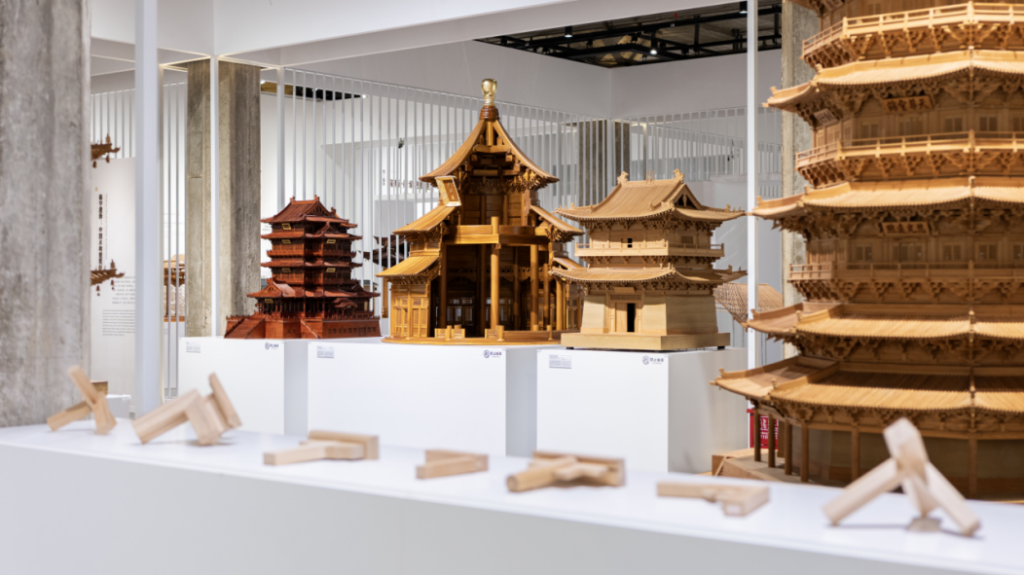
From ancient times to the present day, what defines a dwelling of true distinction? In March, the exhibition Wooden Structures: Joining Tradition and the Future opened in the special exhibitions gallery on the first floor of the WorldSkills Museum, inviting visitors to discover the answer through the lens of skill. Step into a world of masterful craftsmanship that spans centuries of wooden architecture.
Structured around the language of architecture, the exhibition unfolds in four chapters: Chapter 1, Wisdom of Wooden Structures; Chapter 2, Classical Craftsmanship; Chapter 3, Innovation and Inheritance; and Chapter 4, Shaping a Sustainable Future. Spanning from ancient nest dwellings to digital construction, and from intangible cultural heritage skills to cutting-edge technologies, the exhibition weaves together the millennia-long story of wooden structures.
This September, the 48th WorldSkills Competition will take place in Shanghai. Joinery, Carpentry and Cabinetmaking will be among the official competition skills, with contest content including the fabrication of mortise-and-tenon structures, timber processing and wood application.
Taking this exhibition as an opportunity, the WorldSkills Museum offers visitors a firsthand preview of the core skills behind these official skills. Furthermore, as a remarkable milestone in the history of human architecture, traditional Chinese wooden structures carry the nation’s romantic cosmic vision and age-old wisdom of coexisting in harmony with nature. Visitors are invited to discover the inheritance and innovative development of time-honored woodworking craftsmanship right here.
Masterpieces of China’s timber heritage assembled: exploring the very best of the craft all in one place
This exhibition brings together a remarkable collection of classic wooden architecture and fine woodcraft from across China. Visitors in Shanghai can enjoy a one-stop view of the essence of timber craftsmanship without leaving the city.
On display are nine renowned ancient timber landmarks that form a classic matrix of wooden architecture, including the Main Hall of Nanchan Temple – China’s oldest surviving timber structure from the Tang dynasty; Foguang Temple, often hailed as “China’s foremost treasure of ancient architecture”; the Wooden Pagoda of Yingxian County, the tallest surviving wooden pagoda in the world; as well as the Hall of Prayer for Good Harvests at the Temple of Heaven, Tengwang Pavilion, and the Hanging Temple. Through high-precision models, visitors can appreciate the elegance of hip-and-gable roofs that integrate the “four wonders” of Tang architecture—the wooden structure itself, painted sculpture, murals, and calligraphy—as well as the refined carpentry techniques embodied in layouts such as the “three visible, seven concealed” structural system.
An immersive reconstruction of the Hanging Temple has also been created within the exhibition hall, allowing visitors to experience first-hand the awe-inspiring romance of a “tower so high it seems to scrape the stars.”
Notably, the exhibition also features over a dozen selected pieces from the Architecture Model Museum – one of the hardest-to-book museums in Shanghai. Without the need for advance booking, visitors can view works such as In-Bamboo, Siheyuan Residence, Stage of Forest, and Wooden Cube Space, all created by leading designers. In-Bamboo stands out with its distinctive infinity-shaped roof, showcasing new timber structures and design aesthetics shaped by contemporary digital design.
Reconstructed components on display: discovering the secrets in every detail of timber craftsmanship
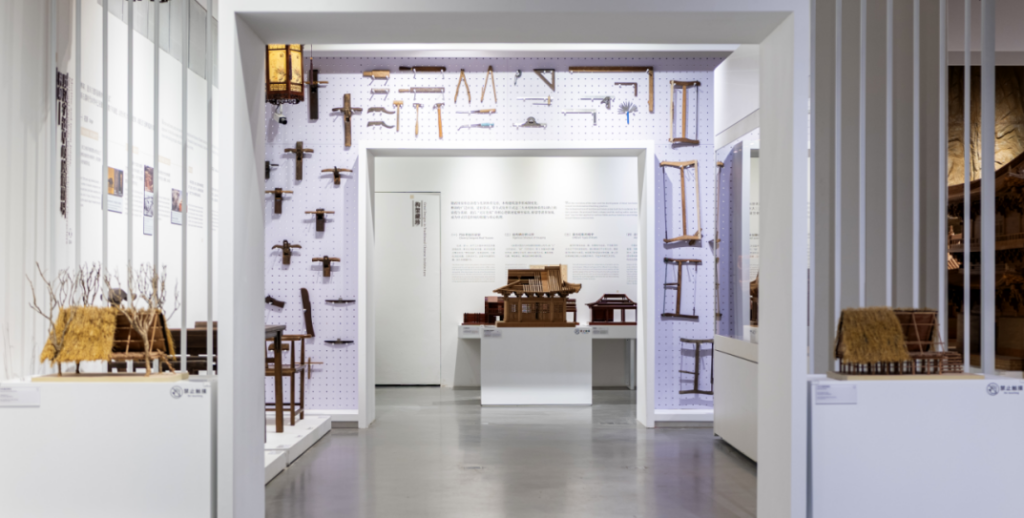
Beyond complete architectural forms, the exhibition also breaks down the fundamental principles of timber construction through history, tools, craftsmanship, building systems, and component design.
Visitors can trace the evolution of wooden dwellings from primitive nest structures to the F901 palace site of Phase IV of the Dadiwan culture, and the sites of Jijiaocheng in Hunan Province, dating back thousands of years. Early mortise-and-tenon components—such as beam-head tenons, double-convex tenons, and column-head tenons—offer a glimpse into the origins of joinery. An interactive area invites visitors to piece together various types of mortise-and-tenon joints, experiencing the ingenuity of ancient craftsmanship.
To present the complete system of traditional woodworking craftsmanship, the exhibition also displays a full set of traditional carpentry tools covering the entire process—from measuring and cutting to chiseling, planing, and polishing. It also features exquisite architectural components such as xuanyu (hanging fish), queti (sparrow braces), niutui (corbels), and roof-ridge decorative animal sculptures, revealing the true names and ingenious functions behind these visually striking elements commonly seen in traditional architecture.
Particularly noteworthy are several Song dynasty-style dougong bracket sets on display, allowing visitors to closely examine the intricate details of one of the three core structural systems in traditional Chinese architecture.
In addition, the exhibition digitizes classical architectural texts through interactive query screens, allowing visitors to consult works such as Kao Gong Ji (Artificer’s Record), Tiangong Kaiwu (Exploitation of the Works of Nature), Luban Jing Jiangjia Jing (Treatise of Lu Ban), and Gongcheng Zuofa Zeli (Standards of Architecture Engineering) on site. Visitors can also view a physical reproduction of Yingzao Fashi (Treatise on Architectural Methods), experiencing the construction wisdom of master craftsmen across generations. Combined with models of traditional buildings such as Siheyuan Residence and Canglang Pavilion, visitors gain insight into the practical application of the Yingzao Fashi methods in traditional architecture.
Over a dozen green building materials to touch and feel: where new technology and design breathe new life into ancient skills
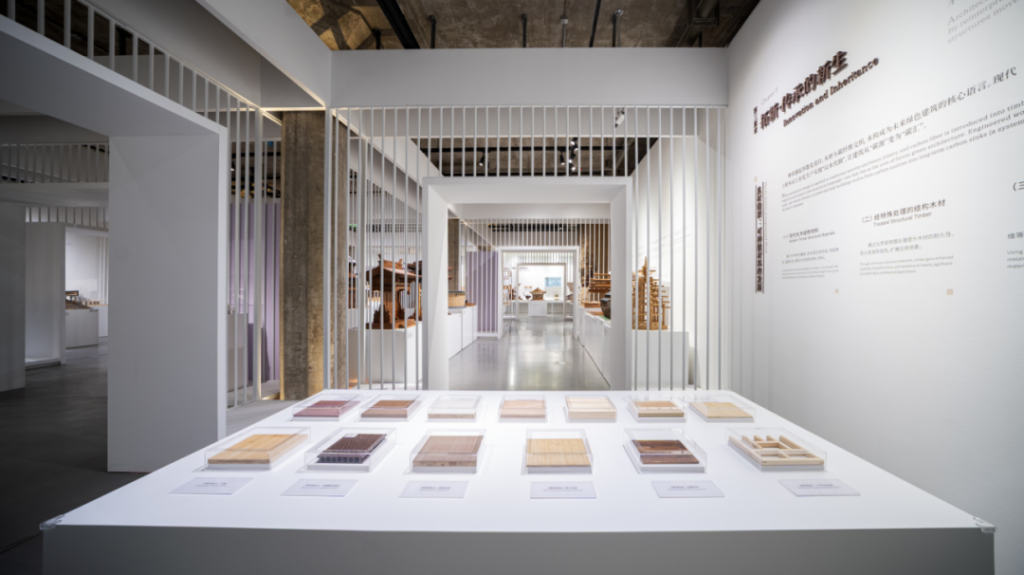
Driven by the power of data, low-carbon and environmentally friendly materials are giving new life to timber construction. The final two chapters of the exhibition further explore contemporary innovations and future possibilities for traditional timber skills, combining models, graphic panels, and tactile experiences.
In Chapter 3, Innovation and Inheritance, visitors can walk along a “materials corridor” and touch more than ten new types of building materials that “replace steel with wood,” gaining a sense of contemporary low-carbon and sustainable design concepts. Models such as the China Pavilion at the Shanghai World Expo, designed by He Jingtang, and the Futian Wedding Hall in Shenzhen—known as the “most beautiful marriage registration hall”—illustrate how new technologies and designs are reinterpreting the language of traditional wooden structures.
The exhibition also focuses on digital construction transformations, including AI optimization, robotic processing, and 3D printing. Visitors will learn about several classic case studies from around the world, such as the world’s first 100% bio-based 3D-printed house developed by the University of Maine in the United States. These examples reveal the green pathways and boundless potential that emerge when traditional timber skills meet modern technology.
Running from 29 March to 14 June, the exhibition is free and open to the public. During the exhibition period, the museum will offer a series of educational and hands-on activities on the same theme, including “Skill Workshops,” “Champion Talks” “Ask the Masters” “Come to Work” and “Learn Many Skills”. Further information will be released through the WorldSkills Museum’s WeChat official account and video channel.